

Book Club is open to everyone and the group meets in the Library on the first floor of the Learning Centre at 1:00pm every other Friday. The first novel read by the group was A Clockwork Orange.
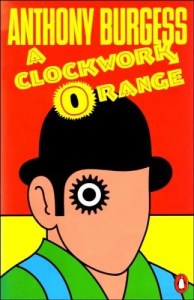
A Clockwork Orange by Anthony Burgess.
The novel, published in 1962, is set in a gloomy, dystopian England. It is a first person account that follows 15 year old Alex and his vicious teen gang of “droogs”, who terrorize society. Immersing themselves in a criminal world of drugs, violence and power. Alex is eventually caught, and is tortured by a tyrannical government, who attempt to “rehabilitate” him using an experimental psychological conditioning technique – aversion therapy. The novel goes on to follow Alex once he is released from prison.
What is A Clockwork Orange about?
A Clockwork Orange is “concerned with the conflict between the individual and the state, the punishment of young criminals, and the possibility or otherwise of redemption.” – The International Anthony Burgess Foundation.
The novel explores the ethical issues surrounding polarized and extreme political systems and asks whether human behaviour is intrinsic, or whether it can be artificially altered.
A Clockwork Orange: what did our students have to say about it?
The session began by discussing the complex language of the narrative and whether students found this challenging. Did they find it overwhelming or confusing? Did they have any thoughts as to why Burgess chose to incorporate such language into his narrative?

The group were initially struck by the language, and discussed at length the intelligence behind what at first appears to be unintelligible jargon. Burgess employs language borrowed from Russian, and intertwines this with childish phonetics, cockney rhyming slang, as well as Shakespearean phrases. The group looked in detail at examples of how Burgess uses language to create oxymorons, paradoxes, and juxtapositions that reflect back on the major themes of the text. Burgess uses words such as “Horrorshow” to ironically mean good, he also inverts the word “lubbilubbing” (the Russian word for love) to represent sexual assault, and Goloss to mean voice – all while incongruously writing a book that avoids semantic clarity via a glossary. Many in the group enjoyed how “flowery, softer” language was used to obscure more violent imagery, as well as Alex’s use of more academic language.
Later in the session, we discussed more thematic approaches. Students discussed their response to the character of Alex and whether they ‘liked’ him. Did their opinion change as they read more of the novel?
One student felt ‘floored’ by the question and reflecting on her response to Alex. She, like others in the group, had developed some empathy and compassion towards the monstrous character of Alex, which initially seemed counter intuitive and conflicted with how she felt she was “supposed” to feel towards such an evil personality. The discussion developed around Alex’s age, only 15, as a probable reason for his childlike-naivety, and there was a shift in blame towards a government that wanted to alter such an innate part of who Alex was. Students found it difficult to determine what good was and what bad was in such a complex and nuanced text – something the group never quite resolved.
Discussion moved on to the topic of censorship. Published in 1962, the novel was banned in several American states, and in 1972 the film adaptation was banned in the UK. The group explored whether there are ethical responsibilities or consequences around creating a morally corrupt, violent, and vulgar representation of people or society. The general consensus was that books should not be banned, and that these kind of stories need to be told to better our understanding of people from all walks of life. These narratives enable empathy, varying perspectives, and encourage students to think critically. Books like A Clockwork Orange are essential in sparking passionate debates among readers, helping to determine where an individual stands with regard to such challenging questions. The group agreed that such books are interesting, entertaining, and even essential.
As the coordinator of the Book Club I was extremely pleased with the thoughtful discussion generated by the book – Rachel Woolfenden.
For more information on how you can join the Book Club, please pop into the Library and speak to a member of staff.
 Aquinas College Library
You must be logged in to post a comment.